

Blepharoplasty in Plano & Dallas, TX | Eyelid Surgery
Patients often seek eyelid surgery when the delicate tissues around their eyes no longer reflect the sharp, rested, and youthful expression they once had. Since blepharoplasty is a procedure defined by millimeters, it demands the hand of a surgeon with exceptional precision and a refined understanding of the face as a whole.
Dr. Derek Sheen approaches blepharoplasty with the same philosophy he brings to facial rejuvenation: the result should be natural, but it should also be meaningful. Eyelid surgery should not make the eyes look hollow, tight, or dramatically changed; it should restore definition, improve the way the eyes sit within the face, and create a clearer, more rested appearance.
This is why Dr. Sheen evaluates more than the eyelids alone. Upper eyelid heaviness often comes from excess skin, a low brow, or both. Lower eyelid bags may be related to fat, skin laxity, muscle weakness, cheek descent, or hollowing beneath the eyes. A good result depends on knowing the difference.
For some patients, blepharoplasty is enough. For others, the most complete result may involve a brow lift, midface lift, deep plane facelift, facial fat grafting, or laser resurfacing. These procedures are not included automatically. Instead, Dr. Sheen carefully considers which procedures will create a more balanced and comprehensive result.
Dr. Sheen’s goal is a restorative, unmistakable improvement: eyes that look more open, more defined, and more awake without looking surgically enhanced.
Continue reading to learn more about blepharoplasty in Plano, TX, or schedule a consultation. Dr. Sheen sees patients from Plano, Dallas, Frisco, Flower Mound, Highland Park, Park Cities, Southlake, Fort Worth, throughout North Texas, and across the DFW metroplex.
Quick Links
- What Is Blepharoplasty?
- Is Blepharoplasty Performed Alone Or With Other Procedures?
- Why Do The Eyes Matter So Much?
- Who Is A Good Candidate For Blepharoplasty?
- Dr. Sheen’s Approach To Upper Blepharoplasty
- Dr. Sheen’s Approach To Lower Blepharoplasty
- How Does Dr. Sheen Approach A Facial Plastic Surgery Consultation?


What Is Blepharoplasty?
Blepharoplasty is eyelid surgery that improves the upper eyelids, lower eyelids, or both. The procedure is designed to remove or reposition the tissue that makes the eyes look heavy, tired, puffy, or less defined.

Upper blepharoplasty focuses on the upper eyelids. In many patients, extra skin begins to hang over the natural eyelid crease. This can make the eyes look smaller or heavier. In some cases, patients feel like they are constantly raising their brows to open their eyes.
Lower blepharoplasty focuses on the area beneath the eyes. This may involve under-eye bags, puffiness, loose muscle or skin, crepey texture, or hollowing where the lower eyelid meets the cheek. The goal is to smooth and refine the lower eyelid area while keeping the natural shape of the eye intact.
Blepharoplasty may be appropriate for patients who notice:
- Heavy or hooded upper eyelids
- Obstructed vision requiring constant brow lifting
- Loose skin hiding the upper eyelid crease
- Upper eyelids that make the eyes look smaller
- Under-eye bags or puffiness
- Hollowing beneath the eyes
- Loose or crepey lower eyelid skin
- A tired look that does not match how they feel
- A less smooth transition between the lower eyelid and cheek
- Makeup becoming harder to apply because of extra lid skin
Is Blepharoplasty Performed Alone or With Other Procedures?
Blepharoplasty can be performed on its own, especially when the main issue and concern is isolated upper eyelid skin or under-eye bags.
In other patients, eyelid surgery is part of a larger facial rejuvenation plan. This is common because the eyelids are closely connected to the brow, cheek, and midface. Treating the eyelids while ignoring those surrounding areas can make the result look less complete or polished.
During your consultation, Dr. Sheen evaluates whether the issue is limited to the eyelids or whether other areas are contributing to the appearance.
Some patients may benefit from blepharoplasty combined with:
- Brow lift for brow descent and upper eyelid heaviness
- Midface lift for cheek descent and lower eyelid-cheek support
- Deep plane facelift for more complete facial and neck rejuvenation
- Facial fat grafting for hollowing around the eyes, temples, or cheeks
- Laser resurfacing for fine lines, texture, and crepey lower eyelid skin
These procedures are not recommended as add-ons for the sake of doing more. They are considered when they will make the result more balanced, more durable, and more natural.
Why Do the Eyes Matter So Much?
The eyes are central to expression and to how the face is perceived as a whole. When the upper eyelids feel heavy, the brows have descended, or the lower lids appear tired, the entire face can look older or less alert.
Brow position is especially important. The brow and upper eyelid function as a continuous aesthetic unit, and treating the eyelid without understanding the position and shape of the brow can create an incomplete or discordant result. In many patients, what appears to be excess upper eyelid skin is actually influenced significantly by brow descent. Removing eyelid skin alone does not correct that underlying problem and can disrupt the natural relationship between the brow and eye.
This is why Dr. Sheen evaluates the brow, upper eyelid, lower eyelid, and midface together. Brow lifting can restore a more open and balanced framework around the eyes. Upper blepharoplasty can refine true eyelid excess, while lower blepharoplasty and midface rejuvenation can address heaviness and fatigue below the eyes.
The goal is not simply to make the eyes look more open. It is to restore the anatomy and proportions surrounding them, so the entire upper face appears more youthful, defined, and harmonious.
Several factors can make the eyes look heavier or more tired:
- A low brow can weigh down the upper eyelids.
- A descended cheek can lengthen the lower eyelid area or create hollowing beneath the eyes.
- Volume loss can deepen under-eye shadows.
- Loose orbicularis muscle around the eye can create puffiness and worsen eye bags.
- Poor skin quality can make the lower lids look crepey, even when the deeper support is good.
For Dr. Sheen, eyelid surgery works best when these details are separated clearly. The improvement can be significant and remarkable, but the plan must match the anatomy.
Who Is a Good Candidate for Blepharoplasty?
A good candidate for blepharoplasty is usually someone who has a tired appearance around the eyes even when they feel rested. Common concerns may include:
- Upper eyelid heaviness
- Loose skin resting on the eyelashes
- A hidden or less visible eyelid crease
- Puffy lower eyelids
- Under-eye bags
- Hollowing beneath the eyes
- Lower eyelid skin laxity
- A tired or worn-down appearance
- Difficulty applying eye makeup because of extra skin
- A desire for a more open, rested look without changing the eyes
The right candidate is also someone who wants a clear improvement while still looking like themselves. Blepharoplasty can create a remarkable change, but the best results do not look severe or artificial.
Patients with significant brow descent may need a brow lift instead of, or in addition to, upper blepharoplasty. Patients who have experienced cheek descent or under-eye hollowing may need a midface lift or fat grafting. Dr. Sheen determines the appropriate procedures during each consultation.
Dr. Sheen’s Approach to Upper Blepharoplasty
Upper blepharoplasty requires precision. Removing too little may leave the eyes looking heavy. Removing too much can make the eyes look hollow, tight, or older.
Dr. Sheen evaluates the upper eyelid crease, skin excess, brow position, eyelid shape, and the way the upper eyelid relates to the rest of the face. The incision is typically placed within the natural upper eyelid crease so that the scar can heal discreetly.
The goal is to restore a cleaner eyelid platform and a more open expression while preserving the patient’s natural eye shape. The result should look refined and definitive, not overcorrected.
In some patients, upper eyelid heaviness is caused partly by brow descent. In those cases, upper blepharoplasty alone may not create the right result. Dr. Sheen may recommend a brow lift if he feels it will improve the upper eyelid area more naturally.
Dr. Sheen’s Approach to Lower Blepharoplasty
Lower blepharoplasty is one of the most delicate areas of facial surgery. The lower eyelid has to remain smooth, supported, and natural in shape.
Patients often describe their concerns as bags, puffiness, shadows, or a tired look. The cause may be protruding fat, hollowing beneath the fat pads, loose orbicularis muscle or skin, cheek descent, or a combination of several issues.
Dr. Sheen evaluates whether the fat should be removed, repositioned, or blended into the surrounding contour. In many cases, the better result comes from preserving or repositioning tissue rather than aggressively removing it. This helps avoid a hollow lower eyelid.
Skin quality is also considered. Some patients benefit from conservative skin removal. Others may need laser resurfacing to improve fine lines, crepiness, and texture. If the lower eyelid-cheek transition is the main issue, facial fat grafting or a midface lift may be part of the discussion.
The aim is a smoother, more rested lower eyelid without changing the natural character of the eye.
How Does Dr. Sheen Approach a Facial Plastic Surgery Consultation?
Remarkable blepharoplasty results begin with understanding why the eyes look tired or heavy in the first place.
Patients often come in asking for eyelid surgery, but the cause is not always limited to the eyelids. In some cases, the issue is extra upper eyelid skin. In others, it is brow descent, lower eyelid fat, hollowing, cheek descent, skin quality, or a combination of several changes. Dr. Sheen’s consultation is designed to separate these concerns clearly, so the plan is based on anatomy rather than assumption.
His blepharoplasty consultations are organized around three concerns: perspective, expectations, and trust.
Perspective.
The consultation begins by looking at the eyes in relation to the rest of the face. Dr. Sheen evaluates the brows, upper eyelids, lower eyelids, cheek position, under-eye hollowing, and overall facial balance. The goal is to understand whether blepharoplasty is the main procedure or whether another area is contributing to the concern.
Expectations.
The conversation covers what eyelid surgery can improve, what it cannot, and what recovery actually looks like. Dr. Sheen is direct about the limits of skin removal, the risks of overcorrection, and whether the result will be stronger with a related procedure such as brow lift, midface lift, or fat grafting. A meaningful result should look natural, but it should also be significant enough to make the eyes look more rested and defined.
Trust.
There is no pressure to proceed. The consultation is meant to give patients clarity about what is happening around the eyes and which approach would create the most balanced result. For some patients, that is blepharoplasty alone. For others, a more complete facial rejuvenation plan may be the better option. Everything begins with an honest evaluation.
The Whole Face Approach to Eyelid Rejuvenation
The eyelids cannot be evaluated in isolation.
In consultation, Dr. Sheen considers brow position, eyelid skin, eyelid shape, fat pads, under-eye hollowing, cheek position, midface support, facial volume, and skin quality. Each of these details affects the final result.
A patient may think they need lower blepharoplasty because of under-eye shadows, but the real issue may be volume loss or cheek descent. Another patient may think they need upper blepharoplasty, but the brow may be sitting too low. In some cases, eyelid surgery alone is exactly right. In others, it is only one part of the plan.
This is where Dr. Sheen’s approach becomes comprehensive rather than formulaic. He does not treat the eyelids as separate pieces. He studies how the upper face, eyes, midface, and lower face work together to determine the correct procedures for each patient, ensuring a remarkable outcome.

Dr. Sheen’s Training and Experience
Dr. Sheen’s approach to blepharoplasty is shaped by his training in facial anatomy, facial aesthetics, and comprehensive facial rejuvenation.
He completed residency training at UT Southwestern, with surgical experience at Parkland Memorial Hospital and the Dallas VA. He then completed advanced facial plastic surgery fellowship training at NYU under three internationally recognized facial plastic surgeons: Dr. David Rosenberg, Dr. Matthew White, and Dr. Philip Miller.
During fellowship, Dr. Sheen trained in brow, eyelid, facelift, rhinoplasty, fat grafting, and revision procedures. This matters because eyelid surgery is rarely just about the eyelids. The brow, cheek, and midface all influence how the eyes age and how blepharoplasty results are perceived.
Dr. Sheen completed additional fellowship training at Asan Medical Center in Seoul, South Korea. During this fellowship, Dr. Sheen developed a broader exposure to and respect for different facial anatomies, aesthetic ideals, and cultural perspectives that helps strengthen this relationship.
Dr. Sheen also served as a clinical instructor at NYU, teaching resident physicians in the operating room while continuing to refine his own surgical approach. His current technique reflects that background: careful planning, respect for anatomy, and a consistent focus on natural movement, facial balance, and durable improvement.
SHEEN
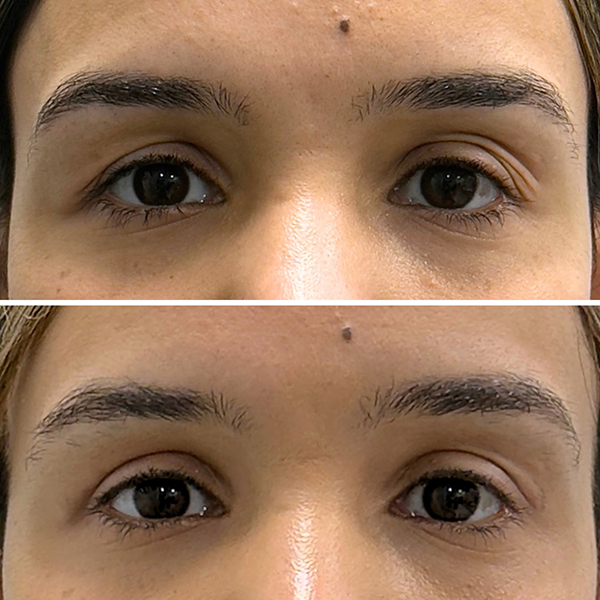
What Does a Good Blepharoplasty Result Look Like?
A strong blepharoplasty result makes the eyes look clearer, lighter, and more rested.
The upper eyelids should look open without looking hollow. The lower eyelids should look smoother without looking tight or rounded. The eye shape should still feel familiar. The expression should look awake, not startled.
For Dr. Sheen, the goal is a natural but unmistakable improvement: cleaner eyelid definition, a more rested appearance, and a result that fits the patient’s face without calling attention to the surgery.


4 Months Post-Op


What Happens During Blepharoplasty Surgery?
The surgical plan depends on whether Dr. Sheen is treating the upper eyelids, lower eyelids, or both.
During upper blepharoplasty, excess skin is removed through an incision placed in the natural upper eyelid crease. In some cases, small amounts of fat may be adjusted, but the goal is to avoid over-removal. The upper eyelid should look cleaner and more open, not hollow.
During lower blepharoplasty, Dr. Sheen addresses the fat pads, skin, and lower eyelid contour. The approach may involve an incision inside the lower eyelid or just beneath the lash line, depending on the anatomy and surgical goals. Fat may be repositioned to smooth the under-eye area rather than removed aggressively.
When needed, laser resurfacing, fat grafting, brow lifting, or midface support may be included in the plan. The details are determined before surgery, based on the patient’s anatomy and goals.
Blepharoplasty may be performed in the office in select upper eyelid cases. More involved eyelid surgery or combined procedures may be performed in a surgical facility.
Blepharoplasty Recovery
Blepharoplasty recovery depends on whether the procedure involves the upper eyelids, lower eyelids, or both. Recovery may also be longer if eyelid surgery is combined with brow lift, midface lift, facelift, fat grafting, or laser resurfacing.
- The first few days are usually the most noticeable. Swelling, bruising, tightness, and mild irritation around the eyes can be expected. Patients should plan to rest, keep their head elevated, and use cold compresses as directed.
- By the end of the first week, many patients feel more comfortable. Bruising and swelling are still common, but the early tightness usually begins to improve. Sutures are often removed around this stage, depending on the surgical plan.
- By two weeks, many patients feel comfortable being seen socially. Some swelling may remain, especially after lower blepharoplasty, but it is usually much less obvious. Makeup may be used once Dr. Sheen clears the patient.
- By three to four weeks, the eyes usually look more settled. The result begins to look more refined as swelling continues to improve. Lower eyelid swelling can take longer than upper eyelid swelling.
- By six weeks, most patients are back to normal routines. Exercise and more strenuous activity are resumed according to Dr. Sheen’s instructions, especially if blepharoplasty was combined with another procedure.
- Final results continue to refine over several months. Incisions fade, swelling resolves, and the eyelids continue to settle. The improvement should look more natural as healing progresses.
Schedule a Blepharoplasty Consultation Today
Dr. Sheen sees blepharoplasty patients from Plano, Dallas, Fort Worth, Frisco, Highland Park, the Park Cities, and across North Texas, as well as patients who travel for consultation.
A blepharoplasty consultation is personal, detailed, and designed to clarify whether the eyelids are the main concern or part of a larger facial rejuvenation plan. To request a consultation, call (972) 316-4555 or submit an inquiry online.
Dallas-Fort Worth Blepharoplasty FAQs
Is upper blepharoplasty the same as a brow lift?
No. Upper blepharoplasty removes extra upper eyelid skin. A brow lift repositions a low or heavy brow. These procedures can overlap because oftentimes a low brow can create the appearance of upper eyelid heaviness. Dr. Sheen evaluates both areas before recommending surgery.
How do I know if I need upper blepharoplasty or lower blepharoplasty?
Upper blepharoplasty is usually considered when the upper eyelids look heavy, hooded, or folded over the crease. Lower blepharoplasty is considered when the concern is under-eye bags, puffiness, or lower eyelid contour. Some patients benefit from both, but the recommendation depends on anatomy.
Can blepharoplasty fix under-eye hollows?
Sometimes, but not always by removing tissue. Under-eye hollows may require fat repositioning, facial fat grafting, or midface support. Removing too much fat can make hollowness worse. Dr. Sheen evaluates the lower eyelid-cheek transition thoroughly before recommending a plan.
Will blepharoplasty change the shape of my eyes?
It should not. The goal is to restore a more rested and defined appearance while preserving natural eye shape. Overcorrection can make the eyes look rounded, tight, or hollow, which is why careful planning matters.
Can blepharoplasty be combined with a facelift?
Yes. Blepharoplasty is often combined with a deep plane facelift when patients want more complete facial rejuvenation. The facelift addresses the lower face, jawline, and neck, while blepharoplasty addresses the eyelids. Combining procedures can create a more balanced result when both areas are contributing to facial aging.
Does lower blepharoplasty help with dark circles?
It depends on the cause. Dark circles may come from shadows created by fat volume loss, puffiness or hollowing, pigment in the skin, thin skin, vascular color, or cheek descent. Lower blepharoplasty can improve shadowing in some patients, but it does not correct every type of discoloration.
Is blepharoplasty painful?
Most patients describe blepharoplasty recovery as tightness, swelling, or irritation rather than significant pain. Discomfort is usually manageable and improves as swelling decreases.
How long does blepharoplasty last?
Blepharoplasty results are intended to be long-lasting. The removed skin or repositioned fat does not simply return, but the face continues to age. Skin quality, genetics, sun exposure, and overall facial aging all influence how results change over time.
Will the scars be visible?
Upper blepharoplasty incisions are placed in the natural eyelid crease, where they typically heal very discreetly. Lower blepharoplasty incisions may be hidden inside the lower eyelid or placed just beneath the lash line, depending on the approach. Scars usually fade over time.
Is blepharoplasty right for younger patients?
Sometimes. Age is less important than anatomy. Some younger patients have hereditary under-eye bags or naturally heavy upper eyelids. Others are better served with nonsurgical care or no treatment. Dr. Sheen will be direct about whether surgery makes sense.