

Facial Fat Grafting in Plano & Dallas, TX
Facial fat grafting can create significant, restorative improvement for patients who notice hollowing, flattening, or volume loss in the cheeks, temples, under-eyes, lips, or lower face. The change can be refined, but it can also be striking because facial volume affects how youthful, balanced, and supported the face appears.
Over time, the face can lose volume in key areas while the deeper tissues descend. This can make the cheeks look flatter, the under-eyes look hollower, the temples look depleted, and the face appear more tired or less defined than it once did.
Facial fat grafting, also called facial fat transfer, uses a patient’s own fat to restore volume and improve facial balance.
Dr. Derek Sheen approaches facial fat grafting as a structural and artistic part of facial rejuvenation. He evaluates the face as a whole, studying the cheeks, temples, eyelids, jawline, lips, chin, neck, skin quality, and facial proportions before recommending a plan.
For some patients, the most complete result may involve a deep plane facelift, neck lift, blepharoplasty, brow lift, laser resurfacing, rhinoplasty, chin implant surgery, or another facial plastic surgery procedure.
Dr. Sheen’s approach is designed to create natural but unmistakable improvement: better volume balance, smoother transitions, stronger facial harmony, and a refreshed appearance that still feels completely at home in the face.
Continue reading to learn more about facial fat grafting in Plano, TX, or call (972) 316-4555 to schedule a consultation today. Dr. Sheen sees patients from Plano, Dallas, Frisco, Flower Mound, Highland Park, Park Cities, Southlake, Fort Worth, throughout North Texas, and across the DFW metroplex.
Quick Links


What Is Facial Fat Grafting?
Facial fat grafting is a facial plastic surgery procedure that transfers fat from one area of the body to specific areas of the face. Fat is typically taken via liposuction from an area such as the abdomen, flanks, or thighs, carefully processed, and then placed in small amounts where volume restoration or contour refinement is needed.
The procedure is sometimes called facial fat transfer because it uses the patient’s own fat rather than synthetic filler. Once the transferred fat establishes a blood supply, some of it can remain long-term and become part of the facial tissue.
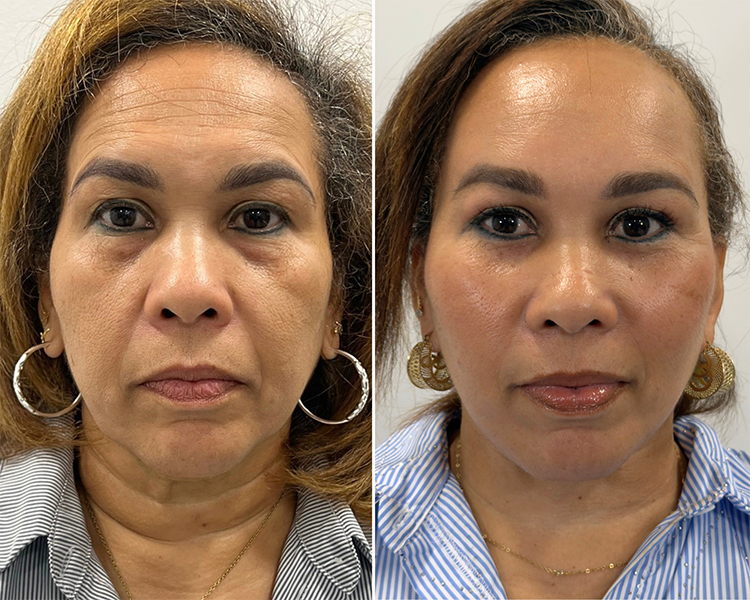
A strong facial fat grafting result should make the face look healthier, softer, and more balanced without looking puffy or overfilled. The improvement can be substantial, but the face should still look natural.
Facial fat grafting may be appropriate for patients who notice:
- Hollow temples
- Flattened cheeks
- Under-eye hollowing
- A tired or depleted facial appearance
- Loss of midface volume
- Deepening folds around the mouth
- Volume loss around the lips
- Facial asymmetry
- A face that looks thinner or less supported with age
- A desire for longer-lasting volume restoration than temporary filler
- A desire for more complete facial rejuvenation with facelift or eyelid surgery
Why Does Facial Volume Matter?
Facial volume affects the way light, shadow, and structure appear across the face.
When the cheeks lose volume, the under-eyes may look more hollow, and the midface may look flatter. When the temples hollow, the upper face can appear more aged or skeletal. When volume is lost around the mouth, folds and shadows can become more noticeable. Even when the skin is treated well, volume loss can make the face look tired.
Several details can affect facial fat grafting planning:
- Temple volume
- Cheek projection
- Under-eye support
- Midface contour
- Lower eyelid-cheek transition
- Nasolabial folds
- Marionette lines
- Lip and perioral volume
- Chin and jawline balance
- Skin thickness
- Facial asymmetry
- Prior filler or prior facial surgery
- Overall facial proportions
For Dr. Sheen, facial fat grafting restores support where it improves facial balance and softens the transitions that make the face look tired or aged.
A comprehensive evaluation helps determine where fat grafting can create the most natural and complete improvement.
Facial Fat Grafting Cost in Plano & Dallas, TX
The cost of facial fat grafting in Plano and Dallas, TX, depends on the areas treated, the amount of fat transfer needed, anesthesia, facility fees, donor site planning, and whether the procedure is performed alone or with another facial procedure.
A focused fat grafting procedure may involve a different plan than fat grafting performed with deep plane facelift, neck lift, blepharoplasty, brow lift, or laser resurfacing.
During your consultation, Dr. Sheen provides a personalized surgical plan and pricing based on your anatomy, goals, and the level of correction needed.
Dr. Sheen’s Approach to Facial Fat Grafting
Facial fat grafting requires sound surgical judgment. Too little volume may not create enough improvement, while too much volume can make the face look swollen, heavy, or unnatural.
Additionally, placement matters as much as the amount used. A small amount of fat placed precisely can create a meaningful improvement, while poorly placed volume can distort the face.
Dr. Sheen evaluates volume loss, facial width, cheek structure, under-eye support, temple hollowing, skin quality, lower facial balance, and the patient’s overall aging pattern before recommending a plan.
Depending on the anatomy, the surgical plan may involve:
- Fat transfer to the cheeks
- Fat transfer to the temples
- Fat transfer beneath the eyes or along the lower eyelid-cheek transition
- Fat transfer around the mouth
- Fat transfer to the lips or perioral area when appropriate
- Correction of facial asymmetry
- Volume restoration with deep plane facelift
- Volume restoration with blepharoplasty
- Volume refinement with brow lift or midface lift
- Laser resurfacing when skin quality also needs improvement
Dr. Sheen’s approach is measured and anatomy-driven. The result should look refined, balanced, and integrated, rather than rounded or overfilled.
How Does Dr. Sheen Approach a Facial Plastic Surgery Consultation?
A strong facial fat grafting result starts with understanding how volume loss affects the face.
Patients often come in focused on tired eyes, flatter cheeks, deeper folds, or a face that looks thinner than it used to. In some cases, facial fat grafting is the main solution. In others, the concern is part of a larger aging pattern involving skin laxity, tissue descent, eyelid changes, brow position, or skin quality.
Dr. Sheen’s facial fat grafting consultations are organized around three concerns: perspective, expectations, and trust.
Perspective.
Dr. Sheen evaluates the face from multiple angles, studying the temples, cheeks, under-eyes, lips, jawline, chin, neck, and overall facial balance. The purpose is to understand where volume restoration would help and where another procedure may be more effective.
Expectations.
The conversation covers what facial fat grafting can improve, what it cannot, and what recovery realistically looks like. Dr. Sheen is direct about swelling, bruising, donor areas, fat survival, asymmetry, and the way final results develop gradually.
Trust.
There is no pressure to proceed. The consultation is meant to give patients clarity about whether volume loss is the main concern or only one part of the issue. Some patients need fat grafting alone. Others may need facelift surgery, eyelid surgery, resurfacing, or a different plan.
Is Facial Fat Grafting Performed Alone or with Other Procedures?
Facial fat grafting can be performed on its own when the main concern is facial hollowing, flattening, or volume loss. Some patients may benefit from facial fat grafting combined with:
- Deep plane facelift when lower facial descent and volume loss are both present
- Neck lift when jawline and neck definition are part of the plan
- Lower blepharoplasty when under-eye hollowing or lower eyelid contour needs improvement
- Upper blepharoplasty when upper eyelid aging is part of the concern
- Brow lift when upper facial heaviness and temple volume loss affect balance
- Midface lift when cheek descent and volume loss both contribute to aging
- Laser resurfacing when skin texture, pigment, or fine lines also need improvement
- Chin implant surgery when lower facial structure affects overall balance
- Rhinoplasty when nose and facial proportions are being evaluated together
These procedures are not added automatically. Dr. Sheen recommends them only when they support a more complete, natural result.

Dr. Sheen’s Training and Experience
Dr. Sheen’s approach to facial fat grafting is shaped by his training in facial anatomy, facial aging, and comprehensive facial rejuvenation.
He completed residency training at UT Southwestern, with surgical experience at Parkland Memorial Hospital and the Dallas VA. He then completed advanced facial plastic surgery fellowship training at NYU under three internationally recognized facial plastic surgeons: Dr. David Rosenberg, Dr. Matthew White, and Dr. Philip Miller.
During his fellowship, Dr. Sheen trained in deep plane facelift surgery, neck lift surgery, rhinoplasty, revsion rhinoplasty, septoplasty, brow and eyelid procedures, facial fat grafting, and comprehensive facial rejuvenation.
During his transition from New York to Dallas, he completed a fellowship in Seoul, Korea at Asan Medical Center under Professor Jong Woo Choi, Chief and Professor of Plastic and Reconstructive Surgery.
The fellowship gave him direct exposure to advanced facial plastic surgery techniques from surgeons at the center of Korea’s global reputation in facial aesthetics, insight he has brought back into his own approach.
Dr. Sheen also served as a clinical instructor at NYU, teaching resident physicians in the operating room while continuing to refine his own surgical approach.
His current technique reflects that background: careful planning, precise tissue handling, structural support, and a consistent focus on natural but unmistakable improvement.
SHEEN
What Does a Good Facial Fat Grafting Result Look Like?
A good facial fat grafting result should make the face look healthier, more rested, and better supported without making it look filled. A good result may also include the following:
- The cheeks may look more lifted and balanced.
- The temples may look less hollow.
- The under-eye area may look smoother.
- Shadows may soften.
- The face may look less depleted and more complete.
The most successful results make the surrounding features look more harmonious. The face should look refreshed and refined, with natural contours and smoother transitions.
For Dr. Sheen, a successful facial fat grafting result is natural but unmistakable. The improvement can be significant and restorative, but it should never look heavy, rounded, or artificial.


4 Months Post-Op


Who Is a Good Candidate for Facial Fat Grafting?
A good candidate for facial fat grafting usually has facial volume loss, hollowing, flattening, or asymmetry and wants a more refreshed, balanced appearance. Common concerns may include:
- Hollow cheeks
- Flat midface contour
- Temple hollowing
- Under-eye hollowing
- A tired appearance despite good skin quality
- Loss of softness in the face
- Deep shadows around the eyes or cheeks
- Folds around the mouth that look more pronounced with age
- Prior filler that no longer creates the desired result
- A desire for longer-lasting volume restoration
- A desire for more complete facial rejuvenation with surgery
The right candidate also understands that facial fat grafting is not the same as filler. Some of the transferred fat will naturally be absorbed during healing, and final results develop over time. Dr. Sheen plans carefully for this process while avoiding an overfilled appearance.
Some patients are better suited for facelift surgery, blepharoplasty, skin resurfacing, filler, or another approach. Dr. Sheen determines the most appropriate plan during consultation.
Facial Fat Grafting Recovery
Facial fat grafting recovery depends on the areas treated, the amount of fat transferred, the donor site, and whether the procedure is combined with facelift surgery, blepharoplasty, brow lift, laser resurfacing, or another treatment.
- The first few days are usually the most noticeable. Swelling, bruising, tenderness, and fullness in the treated areas can be expected. The donor area may also feel sore or bruised.
- The face may look fuller than expected early in recovery. This is normal. Some swelling will improve, and some transferred fat will naturally be absorbed as healing progresses.
- By the end of the first week, many patients feel meaningfully better. Swelling and bruising may still be visible, especially around the cheeks or under-eyes.
- By two weeks, many patients feel more comfortable socially, depending on the extent of treatment and whether other procedures were performed.
- By four to six weeks, the face begins to look more settled. The early fullness softens, and the treated areas begin to look more natural.
- By three months, the result usually looks more refined. Fat survival becomes more predictable, and the face continues to settle into a more stable contour.
- Final results continue to mature over several months. The surviving fat becomes part of the facial tissue, and the final shape should look natural, balanced, and well integrated.
Schedule a Facial Fat Grafting Consultation
Dr. Sheen sees facial fat grafting patients from Plano, Dallas, Frisco, Flower Mound, Highland Park, Park Cities, Southlake, Fort Worth, throughout North Texas, and across the DFW metroplex, as well as patients who travel for consultation. To request a consultation, call (972) 316-4555 or submit an inquiry online. Dr. Sheen and our staff look forward to hearing from you.
Dallas-Fort Worth Facial Fat Grafting FAQs
Is facial fat grafting the same as facial fat transfer?
Yes. Facial fat grafting and facial fat transfer refer to the same general procedure. Fat is taken from one area of the body and transferred to selected areas of the face.
What areas can facial fat grafting treat?
Facial fat grafting may be used in the cheeks, temples, under-eye region, lower eyelid-cheek transition, lips, around the mouth, and other areas where volume restoration would improve facial balance.
Is facial fat grafting better than filler?
It depends on the patient. Filler may be appropriate for smaller or temporary refinements. Fat grafting may be better for patients who want longer-lasting volume restoration or who are already having facial surgery.
How long does facial fat grafting last?
Results can be long-lasting. Some of the transferred fat is naturally absorbed during healing, and the fat that survives can remain long term, although the face continues to age naturally.
Will my face look swollen after facial fat grafting?
Yes. Swelling is expected early in recovery. The face may look fuller than the final result at first. This gradually improves as swelling resolves and the fat settles.
How much fat survives after facial fat grafting?
Fat survival varies from patient to patient. Dr. Sheen explains this during consultation and plans the procedure with the healing process in mind.
Can facial fat grafting fix hollow under-eyes?
It may help selected patients with under-eye hollowing or poor lower eyelid-cheek transition. This area requires careful planning because the under-eye region is delicate.
Can facial fat grafting be combined with a facelift?
Yes. Facial fat grafting is commonly combined with facelift surgery when both tissue descent and volume loss are contributing to facial aging.
Can facial fat grafting be combined with blepharoplasty?
Yes. Fat grafting may be considered with eyelid surgery when volume loss around the lower eyelid or cheek affects the overall result.
Where is the fat taken from?
Fat is commonly taken from areas such as the abdomen, flanks, or thighs. The donor area depends on the patient’s anatomy and the amount of fat needed.
Is facial fat grafting painful?
Most patients describe soreness, swelling, bruising, or tightness rather than severe pain. The donor area may feel sore, similar to a small liposuction recovery.
Will facial fat grafting make my face look overfilled?
It should not. Dr. Sheen uses a measured approach focused on balance and proportion. The intended result is restored volume, not an overfilled appearance.
Can facial fat grafting improve facial asymmetry?
It may improve some types of asymmetry when volume difference is part of the issue. Structural asymmetry may require a different or additional approach.
What if I am not sure whether I need fat grafting, filler, or a facelift?
That is common. Many patients know the face looks tired or hollow but are not sure whether the issue is volume loss, skin laxity, tissue descent, or all of these. Dr. Sheen evaluates the face as a whole and explains which approach makes the most sense.